

Why Doesn't Anyone Wonder About The Relationship Between Submission And Help?
A Glance At Fine Gråbøl's 'What Kingdom'

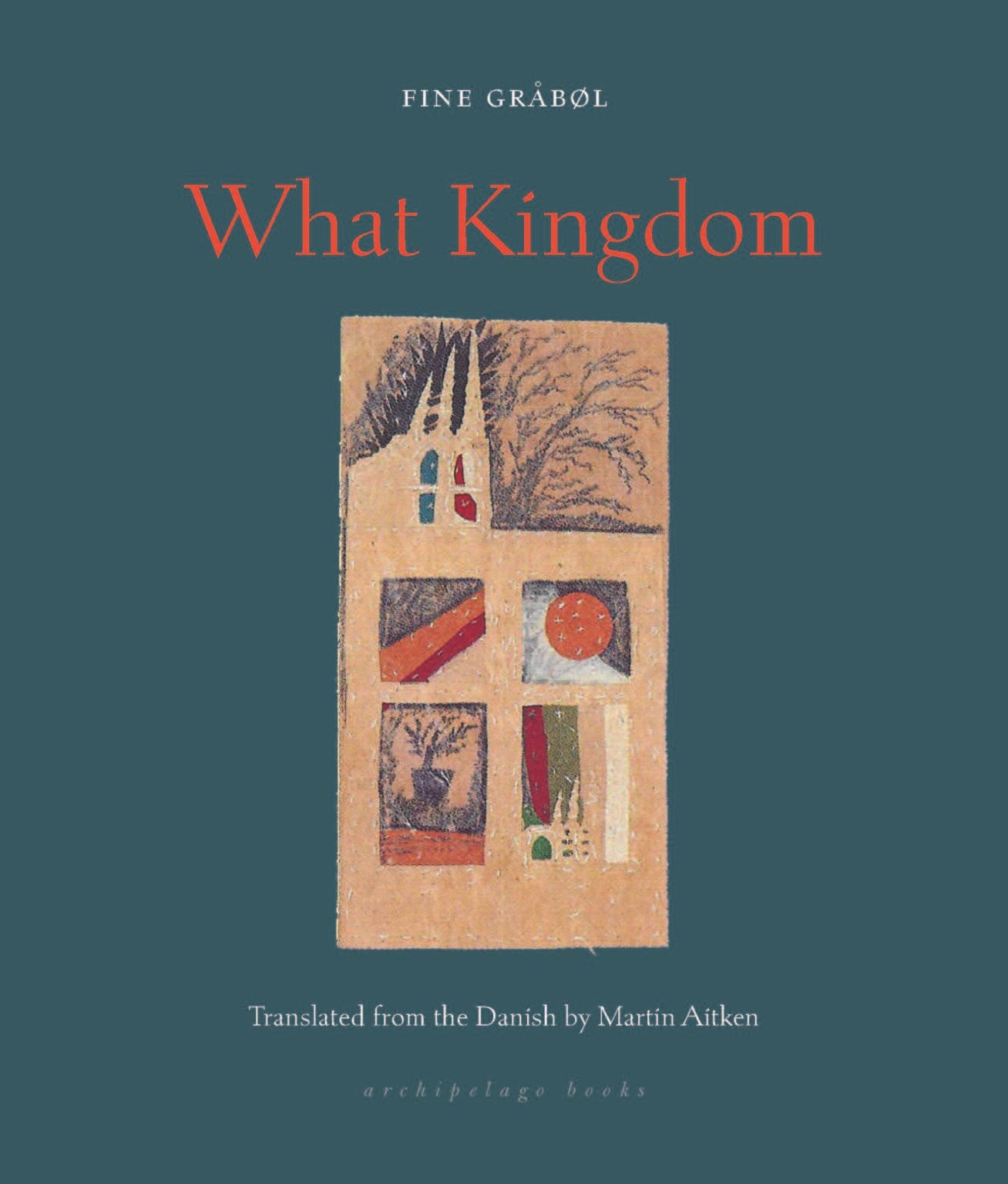
I am a more recent convert to the wonders offered by Archipelago Books, a non-profit publisher—with their instantly recognizable near-square paperbacks—that aims to publish books in English that may otherwise be ignored in the broader market. They have been especially key for my acute affinity for Scandinavian literature, and that example can demonstrate the general output of Archipelago with a lesser known early work by Laxness in The Great Weaver From Kashmir as well as an array of both fiction and non-fiction works by Knausgård including his more central My Struggle sextet along with some of his more peripheral writings. In keeping an eye on their newer output, I would have noticed the titular novel for this writing nearly a year ago. The publisher printing a debut was enticing but my attention was further enticed due to the summary outlining what looked to be an artistic narrative on mental health along with a plug by her contemporary and compatriot Olga Ravn, who is one of the most exciting young writers today. I think with this novel, it also marks the first time in my life that I have been well impressed by the writing of a novelist who is younger than I am. It seems the moments that make me feel old are becoming more and more frequent.
There is certainly a polemical underpinning with the general substantive components of Fine Gråbøl's What Kingdom. The novel is based upon the author's own experiences as a psychiatric inpatient, and her appraisal of the mental healthcare system—even though her writing is never overtly harsh nor outright condemnatory—is the inverse of what is generally supposed among the wider public, especially considering such a wealthy and relatively egalitarian country such as Denmark. As opposed to the wider projections of aid, comfort, health, safety, and compassion that is typically exuded, from the vantage of the first-person narrative in the novel, one views a level of disdain atop a bewilderment that is also feels a bit faded; perhaps the being faded from exhaustion regarding the inefficiency, moral failings, and contradictions of the system she finds herself in.
The narrator spends some time scrutinizing a larger issue, such as the fact that a quite unstable fellow patient is, unbeknownst to either party, in the same facility as her biological mother who gave her up as a small child only for the system she was given to having had now failed that child as well, and now they both reside a few floors away; and what sort of reunion might that facilitate, were it to occur? She also offers smaller details someone unfamiliar with that world may not know of, and even matters possibly not shared by any such patients: the collective bloating among all the patients from the high doses of psychiatric medication; how the daily routines and activities begin to seem more like the point of their time rather rather than the treatments; how insignificant personal items can be hindering reminders of one's perceived personal failings. Whether intentional or not, one salient element is how the narrator captures the impacts of ECT (electroconvulsive therapy), mainly the matter of memory loss, and a general overview of the questionable cost-benefit contrasts that are made. She does so early in the book and then again quite near the end, as if the memory loss from the ECT sessions made her forget what she has and has not written.
I'll make note of three impactful snippets from the novel. The first is a single sentence insert right in the middle of the book in which she writes:
They call containment of the emotional register treatment.
The next follows a longer reflection on the ambiguity that all in her predicament must—or at least should—face in how the boundaries between the side-effects from procedures (ECT, in this case), the side-effects from the medications, and the innate symptoms of condition(s) are all now opaque. As perhaps a lament, maybe an aspiration, or possibly as a spark of hope she notes:
In that light there is no happy recover. Psychiatry exists on the premise of internally directed treatment forms. Could we not imagine treatments that are instead externally directed, involving the outside world gearing itself towards a wider and more comprehensive emotional spectrum? I don't know.
Even though lacking refinement and confidence, this is, indeed, a perspicacious insight. Much of the symptoms and broader problems one accrues is from how their notably different brain is interfacing with the outside world. The impulse is to solely change that brain with little to no restraint when some more external accommodation may at least partially offer some resolve. Of course, even a feeble utilitarianism will denote that too much concession will grant the few to weigh on the many, but the general principle is little considered, if at all, and the urge to a bombardment of treatments hold primacy.
Finally, near the end, the narrator discusses a floor-mate who has recently acquired financial government support and she concludes that insert with a lyrical whim. As with the first, I'll merely note it and allow it to stand as is:
What's a disability pension anyway, other than the promise of a minimum of stability, a narrow rug, the possibility of grass in a crumbling monument.
Apart from the general premise and the gender of the narrator, the novel has little resemblance to, say, a certain mid-century American work which was, as with this, the debut novel of a poet. Stylistically, the work holds similarity to the aforementioned Danish writer Olga Ravn, also someone whose main footing is within poetry. Gråbøl's writing is fragmentary and shifts between descriptive, direct prose, and prose poetry. Captured here is one of her more melodic musings which also is demonstrative of her lyrical instincts:
I know what's going to happen today; the birds know. I know what's going to happen today; the treetops know, they receive the wind. No disruption in the movements of the leaves.
She writes all manner of rapid observations, meditations on furniture, impulses, updates on the weather and insects, translucent interactions, and glimpses of insight.
There are no chapters or page breaks within the novel. Akin to how Ravn formatted her acclaimed book the Employees as largely a series of short HR reports, Gråbøl merely has inserts that are no more than a couple pages at the longest, to as little as the single sentence that I noted earlier on. This style fits the subject matter of someone who is having memory issues and quite easily all manner of attention and awareness difficulties. The quick snapshots also avoid the potential contrivance that may occur with an epistolary format. But maybe Gråbøl, as well as Ravn, are moving in the direction of a more sober literature, and are maybe picking up an important avenue left off with the modernists but not fully and properly travelled. The human mind does not so well flow with a concise narrative, or even one more idiosyncratic and sporadic, but still lengthy and continuous as can be the case with Faulkner or Joyce. Fragmentary and highly incomplete is more grounded in reality, as that is certainly the case with one's memories.
With my own failing memory, I came across a line some months ago from an American writer who a few decades ago noted the scarcity of great new works of European literature in a crass but perhaps not wholly inaccurate fashion. At least I can recall a different quote attributed to Angela Carter: Soon, nostalgia will be another name for Europe. A refrain of mine in my life, and perhaps throughout my writing—so I should restrain myself—is the recession in North American culture, and perhaps the entire Anglo-sphere. Whereas culturally the 20th century was the American one, their time of glory is done: they simply refuse to read the memo. As for literature, there are remnants that pop up here and there with the likes of Ottessa Moshfegh and Joshua Cohen, but the literary environment along with the larger culture in this neck o' the woods has far declined. The usually-correct Will Self has gone on and on about the death of the novel (and film too, for that matter) for quite a number of years now, yet the funeral parlour is still waiting on both. I think it may be simply in ill-health as far as our shared language is concerned. My sense is that within the last quarter century, the latest iteration of cultural flourishment has been lead by those on the European continent and in East Asia. For literature, this entails a period of Ferrante, Murakami, Knausgård, and Kang—to name a highly truncated few. Only because English speakers are trying hard to ignore it, that doesn't make it any less the case. Within such a milieu, What Kingdom now sits among a burgeoning group of Danish women who are moving the art form forward and, more importantly, expanding its canon.